Science & The Swimmer
Univ. of Miami Computational Models Help McCardel on World-Record Attempt
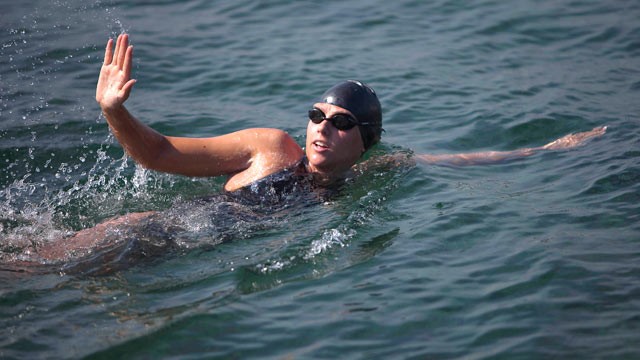
MIAMI – Since 2004 scientists in the University of Miami (UM) Coastal & Shelf Modeling Group have been running high-resolution computational models of the Florida Straits. These studies are informative in terms of the circulation and impact the Straits have on several aspects of the marine life around the Florida Keys, such as the replenishment of the coral reef fish larvae, the transport of substances (including pollutants and nutrients from as far as the Misssissippi River), and hurricanes. However, this summer, statistics from the long term model simulations and real time prediction are also being used for a new purpose: to assist swimmer Chloe McCardel as she attempts to be the first person to swim the 104 miles from Havana, Cuba to Key West, Fla. without a shark cage.
UM Rosenstiel School of Marine & Atmospheric Science faculty member Villy Kourafalou has been involved with McCardel’s team since last January, when she first announced her intent to swim across the shark-infested waters. Kourafalou has served as a local expert, providing scientific information on unique circulation details and predicting movements of the waters in the Straits, which include strong eddies that can wear a swimmer out and pull them off course.
“The eddies are very important and our studies have shown that they work in synergy with the Florida Current so they can strongly influence the meandering of this branch of the Gulf Stream between Cuba and the Keys,” said Kourafalou. “following findings in a breakthrough publication made last year (with group member HeeSook Kang), we were able to provide reliable information to Chloe’s team and influence their strategy for the crossing – including the start date of June 12.”
Together with research group member Matthieu Le Hénaff (of the Cooperative Institute for Marine and Atmospheric Science) Kourafalou met with McCardel’s boat captain prior to the voyage to help establish the optimal swim strategy using solid science. The project also included collaboration from UM alumnus and President of ROFFS (Roffer’s Ocean Fishing Forecasting Service) Mitch Roffer, Jim Franks of the University of Southern Mississippi and UM’s Center for Computational Science. As soon as we were informed of the swim target dates, Kourafalou’s team embarked on non-stop model simulations to provide prediction on currents, and other factors that could impact the crossing.
McCardel left Havana on June 12, and was expected to be swimming for 60 hours. Model predictions, in tandem with satellite data and weather reports, showed favorable conditions. Unfortunately, the swimmer suffered a ‘debilitating’ severe jelly fish sting 11 hours into the swim that made it impossible to continue.
About the University of Miami’s Rosenstiel School
The University of Miami is the largest private research institution in the southeastern United States. The University’s mission is to provide quality education, attract and retain outstanding students, support the faculty and their research, and build an endowment for University initiatives. Founded in the 1940’s, the Rosenstiel School of Marine & Atmospheric Science has grown into one of the world’s premier marine and atmospheric research institutions. Offering dynamic interdisciplinary academics, the Rosenstiel School is dedicated to helping communities to better understand the planet, participating in the establishment of environmental policies, and aiding in the improvement of society and quality of life. For more information, please visit www.rsmas.miami.edu.